

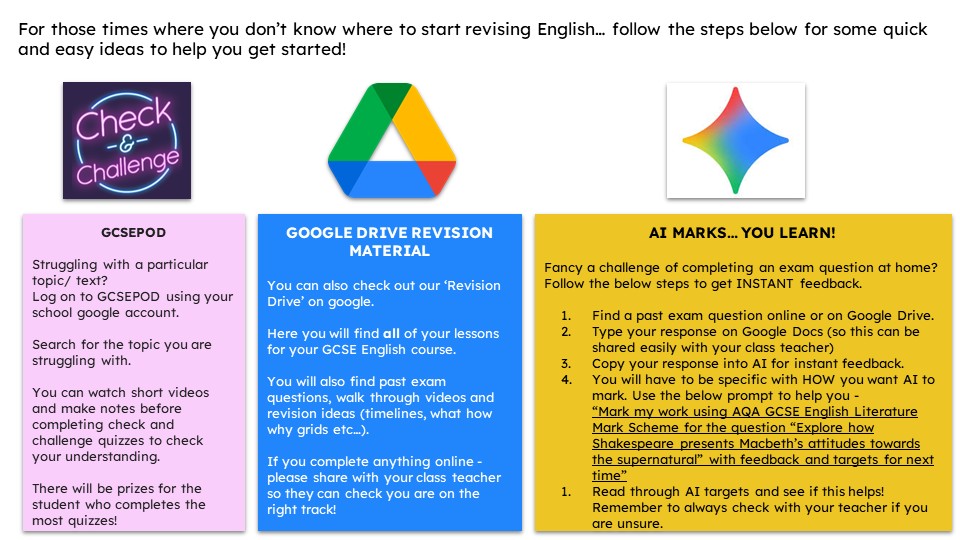
Online Learning Help Sheet for English Revision
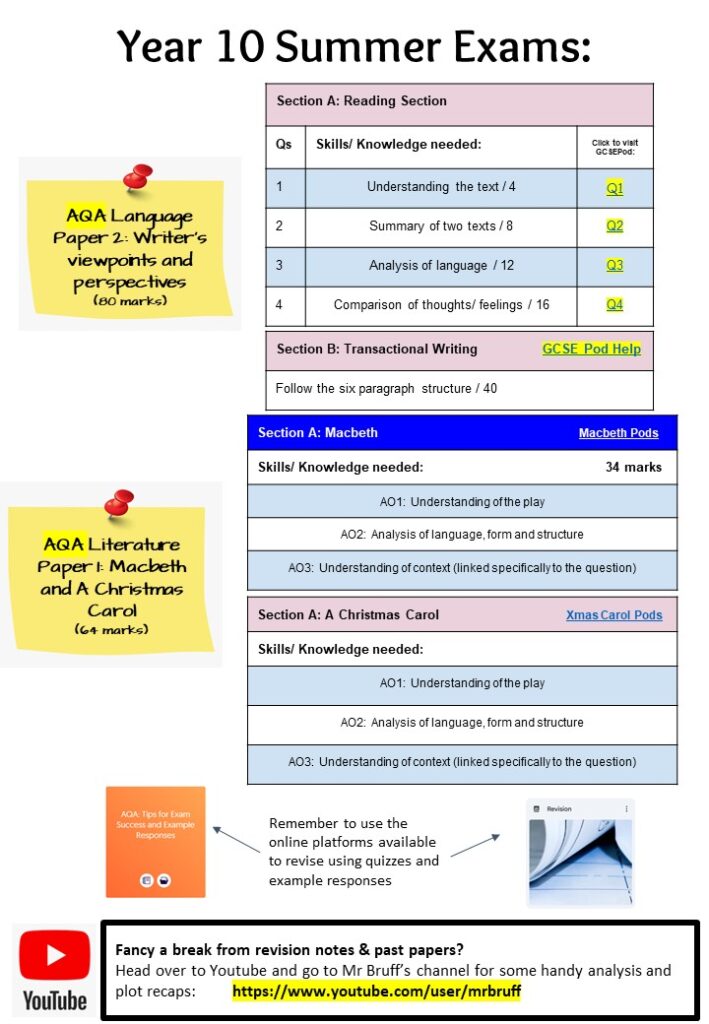
Year 10 Summer Revision List – English Language and English Literature

Students will sit a full suite of papers that covers the entire curriculum. All provided revision resources are based on the DrFrostMaths and Maths Genie websites.
Username: School email address
Password: password (all lowercase)
Support: If students encounter any issues accessing these accounts, they should speak directly with their class teacher.
Science Revision Information Summary PDF Guide
We provide all of Year 10 with a revision pack that includes revision guides, workbooks and flashcards. We also have access to Carousel where students can revise key knowledge recall independently at home.
Year 10 students will need to know all of the information attached to this list.
In Google Classroom folder there is a power point on each topic.
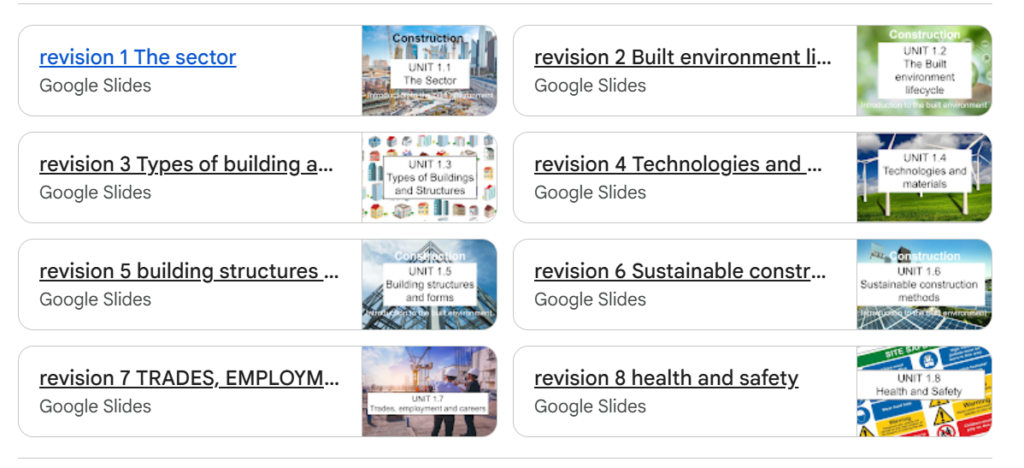
Printed knowledge organisers have been given to students, both hand drawn and printed versions.
Construction Unit 1 Knowledge Organisers
Complete Guide to Revising Construction – a booklet with knowledge organisers and exam questions with answers to really test themselves.
Students can also access the EDUQUAS website and download past papers and answers, however, every single exam question and answer is included in the complete construction guide.
The books below can be purchased online

Edexcel GCSE Statistics Topics
Edexcel GCSE Maths can be broadly divided into the following topic areas:
1. The Collection of Data
2. Processing, Representing & Analysing Data
3. Probability
1. The Collection of Data
The collection of data involves gathering information systematically to analyse patterns, trends, and relationships. This topic covers different data types, sampling methods, and ways to ensure reliability and accuracy in statistical investigations.
Collection of data topics include:
- Statistical Enquiry Cycle
- Hypotheses & Constraints
- Types of Data
- Multivariate Data (Higher Only)
- Population & Sample Types
- Stratified Sampling – Multi-Category Stratification is Higher Only
- Collecting Data – Level of Control & Random Response Technique is Higher Only
- Questionnaires & Interviews
- Cleaning Data
- Extraneous Variables – Control Groups & Matching Pairs is Higher Only
2. Processing, Representing & Analysing Data
Processing and analysing data involves organising, displaying, and interpreting information to draw conclusions. This includes using charts, graphs, statistical measures, and correlation to compare and understand datasets.
Tabulation, diagrams & representation topics include:
- Bar Charts, Line Graphs & Pictograms
- Pie Charts – Comparative Pie Charts is Higher Only
- Stem & Leaf Diagrams
- Two-way Tables & Venn Diagrams
- Population Pyramids
- Choropleth Maps
- Cumulative Frequency Charts
- Box Plots
- Frequency Polygons
- Histograms – Frequency Density is Higher OnlyMeasures of central tendency topics include:
- Mode, Median & Arithmetic Mean
- Mode & Mean from Grouped Data
- Linear Interpolation
- Transforming Data
- Weighted Mean (Higher Only)
- Geometric Mean (Higher Only)
Measures of dispersion topics include:
- Quartiles & Percentiles
- Range & Interquartile Range (IQR)
- Interpercentile Range & Interdecile Range (Higher Only)
- Standard Deviation (Higher Only)
- Outliers – Calculating Outlier Boundaries is Higher Only
- Choosing & Comparing Measures of Central Tendency
- Comparing Data Sets
- Standardising Data (Higher Only)
- Skewness – Calculating Skewness is Higher Only
Index numbers and rates of change topics include:
- Index Numbers
- Weighted Index Numbers (Higher Only)
- Chain Base Index Numbers (Higher Only)
- Crude Rates of Change
- Standardised Rates of Change (Higher Only)
Scatter diagrams and correlation topics include:
- Scatter Diagrams & Correlation
- Lines of Best Fit
Regression Lines (Higher Only) - Spearman’s Rank – Calculating Spearman’s Rank is Higher Only
- Pearson’s Product Moment Correlation Coefficient (PMCC) (Higher Only)
Time series topics include:
- Time Series Graphs
- Moving Averages
- Trend Lines
- Mean Seasonal Variation (Higher Only)
Quality assurance and estimation topics include:
- Distribution of Sample Means (Higher Only)
- Control Charts (Higher Only)
- Estimating Population Characteristics
- Petersen Capture Recapture Formula (Higher Only)
3. Probability
Probability explores the likelihood of events occurring and helps to make predictions based on data. It covers key concepts like probability laws, independent and conditional events, and the binomial and normal distributions.
Probability topics include:
- Probability Scale
- Expected Frequency
- Estimating Probabilities from Data
- Relative & Absolute Risks
- Identifying Possible Bias
- Addition Law & Mutually Exclusive Events – General Addition Law is Higher Only
- Independent Events
- Conditional Probability
- Sample Space Diagrams
- Two-way Tables for Probability
- Venn Diagrams for Probability
- Tree Diagrams
Probability distributions topics include:
- Characteristics of the Binomial Distribution (Higher Only)
- Calculating Binomial Probabilities (Higher Only)
- Characteristics of the Normal Distribution (Higher Only)
Year 10 Computer Science Revision Support
Exam Board: OCR J277
 What is on the Exam?
The exam will cover the first four units of Component 1 (Computer Systems). Students should focus their revision on these specific topics:
1.1 Systems Architecture: Inside the CPU, Von Neumann architecture (Registers), CPU performance (clock speed, cores, cache), and embedded systems.
1.2 Memory and Storage: RAM vs. ROM, flash memory, Secondary Storage, Data Representation
1.3 Computer Networks, Connections & Protocols: Types of networks (LAN/WAN), factors affecting performance, client-server models & peer to peer, topologies, and internet protocols (e.g., HTTP, HTTPS, FTP, SMTP).
1.4 Network Security: Threats to networks (malware, phishing, brute-force attacks) and how to prevent them (firewalls, encryption, strong passwords).
 Top Revision Tips for Parents & Students
Flashcards for Keywords: Computer Science is heavy on technical terminology. Use flashcards (or apps like Quizlet) to master definitions for protocols and CPU components.
The “Blurt” Method: Have your child read a section of their notes, close the book, and write down everything they can remember in 2 minutes using a red pen. Check what they missed.
Teach the Parent: Ask your child to explain the difference between RAM and ROM to you. If they can teach it simply, they understand it.
Cornell Notes: Divides the page up into sections which allows for succinct notes to be taken that are organised
 Recommended Websites & Online Learning
Students can access these highly effective, free resources from home:
Craig ‘n’ Dave (YouTube): Short, video-by-video walkthroughs explicitly designed for the OCR J277 course. Excellent for visual learners.
BBC Bitesize (OCR GCSE Computer Science): Perfect for quick summaries, diagrams, and mini-tests for Units 1.1 to 1.4.
Seneca Learning: An interactive, smart revision platform. Search for “OCR Computer Science J277” to practice specific topic quizzes.